
We often hear about filters getting clogged or irrigation systems getting blocked. Sometimes, choosing the most suitable filter to install in an irrigation system is not as easy as it might seem, as it can depend on various factors. Today, there are several types of filtering systems available on the market, in different sizes depending on the water flow, the degree of impurities in the water, and the type of impurities present.
Often, the choice of the filter is secondary to other considerations, but the life of our irrigation system and, more generally, the entire system that leads to plant irrigation depends on it. Suffice it to say that if a subsurface irrigation system were to be installed, the choice of the filter is crucial for the correct functioning of the entire circuit that leads to irrigation.
The purpose of this article is to illustrate the different types of "agricultural use" filtering systems in order to clarify to the agricultural operator and, more generally, to the end-user, what the optimal operating conditions for the various types of filters are, and how to choose the best system for their irrigation setup.
A crucial point in choosing the filter is the type of impurities. Today, there are various types of filters on the market based on the type of impurities present in the water. The biggest mistake, which is often made, is to take for granted that any filter will work regardless of the type of impurities present in the water. Sometimes it is even necessary to install several different types of filters to minimize the risk of blockage in the irrigation system.
Let's now analyze the different types of filters available on the market.
The first filter we will analyze is the hydrocyclone filter. This filter has a funnel shape which, by creating a vortex inside, separates sand from water. Therefore, this type of filter is useful when water contains a significant amount of sand and, as often happens, must be applied to water coming from wells or, in some cases, even from rivers and lakes. This type of filter requires coupling with another filter as it is only suitable for separating sand (heavier) from water. This type of filter is currently available on the market in different materials (iron, plastic, etc.) and with different flow rates.
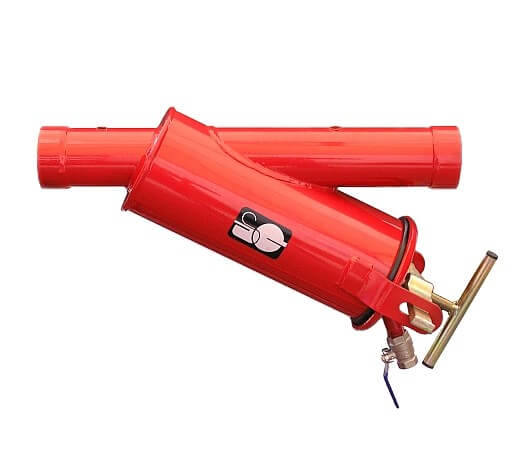
Now we come to the most commonly used filter on the market, the "screen filter". Today, there are various types of screen filters available: single cartridge, double cartridge, self-cleaning with a brush, and without a brush. The widespread use of this filter stems from the fact that it can be used for different types of impurities, is easily transportable, and easy to clean. For this type of filter, its use is not recommended when high quantities of impurities are present, where a specific filtering system for that type of impurity is required. Regarding the filtration degree, it should be proportioned according to the filtration required by drip line manufacturers. For example, if our irrigation system requires a drip line with a required filtration of 120 Mesh, the screen inside the filter should be 120 mesh or slightly higher to prevent clogging of the drippers.
Another widely used filtering system is the Quartz Sand Filter. This filter can be single-chamber or double-chamber. It appears as a filter containing quartz sand, which can be of various thicknesses depending on the degree of impurities. This type of filter is most commonly used when large quantities of algae are present, for example, when the water comes from canals, lakes, etc. Thanks to the quartz sand inside and the nozzles at the base of the filter, it can retain large quantities of impurities present in the water and expel the dirty water through a backwash process. In the case of a single-chamber filter, backwashing is performed with dirty water, while in the case of a double-chamber filter, it is performed with clean water coming from the chamber through which the water has been filtered. Usually, a screen filter is installed at the outlet of this filter, which in this case becomes a "safety filter" as it allows us to monitor both whether the quartz inside the filter "is doing its job" and whether the nozzles at the base of the filter are not damaged (and thus in this case we would find quartz in the screen filter).
Regardless of the type of filtering system used, another fundamental element is the FLOW RATE of the filter. Filters of various sizes are available on the market depending on the flow rate. To better understand the choice of filter sizing, let's take a practical example.
We have a drip irrigation system with 120 Mesh filtration, with a flow rate of 10 liters per second. The water source is a canal, and the pump for drawing water is capable of drawing the 10 liters per second needed to run our system. Water analysis shows a strong presence of algae and various impurities. For these conditions, we will choose a double-chamber filter with a capacity of 20 liters per second. Why this choice? Oversizing the filter compared to the actual flow rate of our system allows us to reduce the clogging process of the filter itself, which leads to faster wear of the quartz inside, and in some cases, can result in the passage of impurities that cause clogging of our irrigation system.
Through this example, we wanted to highlight how oversizing a filter not only reduces the number of washes (which implies the constant presence of an operator) but also reduces the risk of wear of the quartz, which in some cases can deteriorate even after a single clogging event.
The discussion about oversizing the filter does not apply to the "Hydrocyclone" filter, which, needing to create the so-called "vortex" inside it, requires sizing that in some cases may even be smaller than the flow rate of our system.
Today, various accessories are available on the market that help preserve our filter from the risk of breakage, such as safety valves that prevent the risk of high pressure (in case of malfunction, filter clogging, or closing of the system outlet) causing the filter itself to break.
Furthermore, if there is an uphill line, to avoid water hammer which causes filter breakage, it may be necessary to install a check valve that eliminates this risk.
Another tip to extend the life of a filter is to install the fertigation system after the filter. Often, one hears of farmers who, to avoid the passage of undissolved fertilizer particles, carry out fertigation before the filter. This technique can lead to the aggressiveness of some products causing greater wear of the filter and thus reducing its life. Therefore, it is advisable, in addition to respecting the expected times for fertilizer dissolution, to also install a filter (even 1") at the outlet of the fertigator to retain any particles that have not completely dissolved.
As defined in the other article "Manual Filters vs Automatic Filters", the installation of an automatic filter is always recommended, as it results in less management and wear of the filter itself and the filtering element.
HAPPY FILTERING TO ALL!!!