
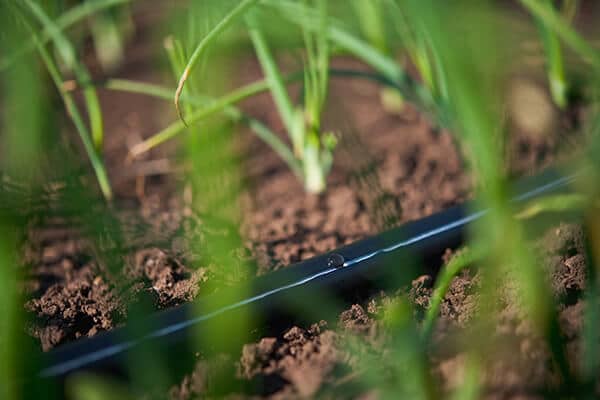
Lightweight drip tape (Drip Tape and Drip Hose) is a low-cost irrigation system that significantly reduces the costs associated with developing an irrigation system. This type of system is usually for single-season use, although today, thanks especially to the development of new thicknesses that make it more resistant and easier to collect once the work in the field is finished, it can also be used for multiple seasons.
But now let's move on to some technical information to make the use of this irrigation system efficient.
Drip tapes are an irrigation system that maximizes their utility by working at low pressures (usually 1 bar) for two reasons:
1) The first is that the maximum lengths recommended by manufacturers usually allow for dripper uniformity (around 90%) with maximum slopes of 3% (it should be noted that this article discusses regular drip tapes and not self-compensating ones).
2) Working at higher pressures risks, in addition to NON-uniformity in the drip system, breakage of the drip tape and in some cases a weakening of the tubing which, even when working at lower pressures at a later time, can lead to the tubing breaking.
In this article, we will focus mainly on the first point highlighted previously to understand how to maximize the utility of lightweight drip tape.
Today, there are different types of lightweight drip tape (drip hose) on the market, both in terms of diameters and thicknesses. Regarding diameter, today we find drip tapes of 16, 22, 25, and even 29. Very often, users choose this irrigation system thinking that a larger diameter drip tape will result in a greater dripper throw. Nothing could be further from the truth. The choice of the diameter of the lightweight drip tape affects only the distance the tubing can reach in the field.
Let's technically analyze this aspect with a practical example:
With a 16 mm drip tape with dripper spacing of 30 cm and a flow rate per dripper of 1.5 LT/H, the maximum achievable distance (on flat ground or with a slope of less than 3%) is about 150 m with an uniformity of about 90% working at a pressure of 1 Bar. While with a 22 mm drip tape under the same conditions (22/30/1.5LT/H), the maximum achievable distance is about 190 m. This applies to all types of drip tapes regardless of their types and flow rates. Therefore, if we install a 25 mm or 29 mm drip tape with the same characteristics as the 16 mm one, we will simply be able to reach a greater distance, but the dripper's throw will always be the same.
If we increase the working pressure (contrary to what one might think) we will have a negative effect on the tubing's performance, as the previously seen dripper, which has a flow rate of 1.5 lt/h at 1 Bar, with a higher pressure, for example 2 bar, will have a flow rate of 2.2 LT/H.
To better understand this aspect, let's analyze two 16 mm drip tapes with different characteristics. The first is the one with the characteristics described previously (16/30/1.5) and we will compare it with another 16 mm drip tape, also with dripper spacing of 30 cm but with a higher flow rate, 2.4 LT/H. As we said previously, with a 16/30/1.5 drip tape, the maximum achievable distance is about 150 m, while with the drip tape with a 2.4 LT/H dripper, the maximum achievable distance is about 103 m, still at 1 Bar of pressure (16/30/2.2LT/H). Therefore, the maximum achievable distance will be less than the tubing with a 1.5 LT/H dripper.
What does this mean???
Previously, we saw how a 16 mm drip tape with a 1.5 LT/H dripper working at 2 bar rather than 1 bar will have an ACTUAL flow rate of 2.2 LT/H, and consequently, the maximum achievable length will not be 150m but 103m. Therefore, it assumes the same characteristics as the one with a 2.2 LT/H dripper. This is the fundamental aspect because it determines that if a drip tape is installed at a length of 150m, as it is the maximum achievable throw for that 16/30/1.5, and the working pressure is 2 bar, in reality, there will be a length of approximately 103m. Therefore, there will be NO UNIFORMITY in irrigation and fertilization within the field, and consequently, as often happens, there is a risk that there will also be no uniformity during harvesting, and this is all at the expense of the farm's economy.
Nevertheless, the choice of the irrigation system to be installed must always be made, first and foremost, based on the plant's needs, then also based on the type of soil, and finally based on the land's predisposition and the farmer's needs.
The choice of the type of drip tape to install (16, 22, 25 or 29) can be a choice that significantly impacts the economy of a farm, as the price of drip tapes is certainly lower than that of a 75 or 90 pipe. Therefore, reaching greater distances with lightweight drip tape can lead to a reduction in the meters of main and secondary line to be installed. According to farmers, another significant advantage is during work and treatments in the field, as it allows for reduced time in that phase.
We hope this article has clarified some fundamental points in choosing the irrigation system to install, and moreover, the principles outlined in the various examples also apply to rigid drip lines.
HAPPY IRRIGATION TO ALL!!!